Thursday, November 19, 2009

Looking out ahead, and where we are

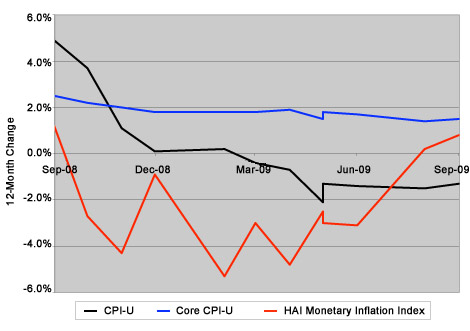
0.03 0.24 -0.38 -0.74 -1.28 -1.43 -2.10 -1.48% -1.29 -0.18

CPI price changes for 2009 (Inflation Data)

From the CPI numbers above for the months of 2009, we can see that the deflationary retail pattern has abated. So, for whatever happened in this phase of the Recalculation, the retail sector has made its adjustment. With the retail sector stabilized, we see that oil is just under $80/barrel. When we are constrained by oil, and the retail sector has zero inflation, then that price of oil is an estimate of the medium equilibrium price or oil, representing the oil price we have to pay to pump goods through the retail sector with stability. So we have an economic data point built using the distance between wholesale oil prices and retail consumer price volatility.

Poil = Fcpi I rely in the price of the constrained good as a function of retail price volatility. This statistic should be good when the economy is constrained by a single essential input, like energy.

The economy will treat this condition as the new normal. If oil prices rise, the retail sector will threaten a round of deflation, pushing oil prices back down. The new normal changes due to increased oil efficiency around regional economies. Economies that gain in relative oil efficiency will see relative gains in currency. Developing regions have the most to gain coming from the least efficient. The dollar will retain reserve status to the extant that relative USA oil efficiency gains outpace the developing world.

Other economic issues:
I think the pension and health care costs are painful, but orthogonal to the energy issue. Cause goes from energy to pension, to the extent that we fail to increase energy efficiency, pensions will continue to devalue while local government increasingly goes bankrupt. Federal involvement in the health insurance industry will be very disruptive to the medical industry, but medical goods are not a direct constraint in the economy.

So my conclusion is straight forward. Future economic conditions depend on the specific application of technology to increase energy efficiency.

Thursday, November 12, 2009

I only take TIPs


Why the square wave pulse in the TIPS yield?

My claim here is that TIPs was reacting to the strong deflationary trend in the collapse, especially commodities. We get a square wave because events happen faster than the Fed can react. So that square wave measures the reaction time of the Socialist Monetary Bank in America.

(HT from Money Illusion, who borrowed the chart)

Back to the title. The mother asked the rabbi how much he charges for circumcision. The rabbi replied that he only takes TIPs.

Tuesday, November 10, 2009

When the economy deals with a resource constraint

Aggregate Output mostly follows the constrained resource flow.

Output, as a function of the constrained resource is highly concave downward. That means the economy gets the highest payoff by applying technology to the constrained resource, money flows to the bottlenecks.

If we use a multi-stage flow model then econometrics would become statistical queuing problem. A linear multi-stage queue would be a collapsed version of a spanning tree, in the more generalized case. The economy, as a spanning tree under a severely constrained input, will have a backbone determined mainly by the efficient delivery of the constrained resource. Technology allows us to build appropriate sub branches around the backbone.

So, if we held to a structural theory (rather than hydraulic) down to the transaction level, then each transaction is a partial rebalance of the total spanning tree, an additional branch on one side, the destruction of a branch on another side. Asymmetry modifies the branch decay/growth process, branch decay occurs faster. Constant uncertainty says that the tree is further restricted in growth to have a strong self similarity, as fractalists point out.

The last point is the more difficult. If we take the banker's yield curve, interpreted as the simple linear multi-stage stochastic flow, then the curve will be a weighted composite of inventory flows of all goods, including banker's goods. So if you take the banker's curve, grap it in the middle with your finger nails, and sort of spread it out into its spanning tree form, the sub branches that result look like the main backbone, but to a lesser degree as the tree unfolds. Each sub branch will be coherent with the finite boundaries of the backbone because it follows the aggregate division of available certainty across and the optimum shaped term structure.

The premise of constant uncertainty and our level of collective action are highly related biologically and economically; a bridge that sorts of connects economics and biology. There is a level of observed similar activity among our neighbors that triggers in us level of certainty that action is useful. When we see regular numbers of workers with lunch pails we are excessively certain that it is a work day, the certainty synapse fires as Kling might say.

Monday, November 9, 2009

LIDAR vision in the car


LIDAR emits an LED beam then uses a standard focal plane array (like in a digital camera) to collect reflections. This LIDAR can pick up actual people in its surroundings. LIDAR prices are dropping.

What I am reading

Reading the Models and Agent post.
Chevelle does a great job of defining the term 'carry' in terms of carry trade, then goes on to make the case that the recent run up in equities is not yet over-leveraged.

Understanding Society on motives for collective action.
Daniel Little talks about what I call the bias toward collective action. Under what conditions will individuals cede their individuality to organized activity. Quantum Mechanical theories of economics rely on finite dimensionality, the sometimes inability of the economy to find smooth paths ahead. (HT Mark Thoma).

Three-Toed Sloth on Shadow Price of Power.
This article talks about a test to determine if a samle came from one of two different collections., say signal from noise.
crshalizi derives the separation ration of Signal to Noise (SNR). When a measurements exceeds the ratio, select signal; otherwise select noise. The post then argues that the economy searches for the optimum ration in pricing a good. That is the economy seeks to manage production such that variation in output has enough power to yield the optimum Signal in the market Noise. (HT Brad DeLong)

John Taylor's post on Governmentn failure vs Market failure.
I agree, most of our economic dislocations come from mis-guided government policy.

Brad Zigler in Bottomng of Inflation Data
Brad talks about the Hard Assets Index, explained by Seeking Alpha.


Is the Hard Asset Index a leading indicator of urban price inflation?

"The HAI monetary inflation index is derived by calculating the difference between gold's appreciation rate in dollars versus its euro-denominated gains."
The Urban CPI, which remains negative seems to track the HAI, and that is trending up. Hence, accordingly, one would predict the urban CPI numbers coming out in Nov 15 will show -.5% to 0% change.

Compare the HAI to this post of mine on Gold and Oil. Gold acts like oil until the crash when gold acts like a monetary reserve. So, across that span, gold seems to track the constraining resource. Interesting, and at least allows us to use the gold based HAI over the break.

Friday, November 6, 2009

A global warming lawsuit.

A New Orleans lawyer passes a legal test in a global warming lawsuit.

Thursday, November 5, 2009

Pension Madness in Southern California

Pension Watch has been keeping us up to date on the madness of a water district in southern California asking for a 25% forward and retroactive pension increase. The story shows how the insiders fake a negotiation between management and labor, when they are both in cahoots to defraud the taxpayer.

Tuesday, November 3, 2009

Mish on Gold, Updated


A good read.

After reading Mish my take away was that in financial stability Gold becomes the industrial market and in times of financial distress Gold becomes money. So we are really watching two markets here, the role of Gold in money remains dormant when fiat systems seem stable.

Looking at Gold vs Oil.


Comparing the oil and gold charts above, notice that they track until mid-2008, then they decorrelate. What happened is that the financial distress causes currency uncertainty leading to the emergence of a dormant 'gold is money' market. After mid-2008, told switches entirely from its industrial use to its monetary use. Two completely different markets.

The bull market in Gold comes when it is needed to store value, temporarily, like the Chinese do to offset volatile currency. So during periods of financilal distress, industrial users of Gold delay their work as Gold is diverted to the money market. As recovery begins, industrial users of Gold get the stuff cheap and their business booms.


Update:

FT reports tha India's central bank buys $6.7 billion of Gold swapped for dollars:

"India’s decision to exchange $6.7bn for gold equivalent to 8 per cent of world annual mine production sent the strongest signal yet that Asian countries were moving away from the US currency."

So short the industries that are heavily dependent on Gold as an input.

Monday, November 2, 2009

An interesting LA Times editorial

By a visiting scholar at Claremont McKenna College.

He compares high tax high benefit states, California; with low benefit low tax states, Texas. He concludes Texas is better off.

Key quotes:

"One way to assess how Americans feel about the different tax and benefit packages the states offer is by examining internal U.S. migration patterns. Between April 1, 2000, and June 30, 2007, an average of 3,247 more people moved out of California than into it every week, according to the Census Bureau. "

"According to a report issued earlier this year by the consulting firm McKinsey & Co., Texas students "are, on average, one to two years of learning ahead of California students of the same age," even though per-pupil expenditures on public school students are 12% higher in California."

Sunday, November 1, 2009

Robert Reich calls a time out on health care?

That is something new. Robert says:

"If Obama and the Democrats lose one or both houses of Congress in the midterms, it will be because the president learned only the most superficial lesson of the Clinton years. Health-care reform is critically important. But when one out of six Americans is unemployed or underemployed, getting the nation back to work is more so."

Like a bad cop/good cop. Threaten us with a trillion dollar health care plan then settle for half trillion second stimulus.