Wednesday, February 24, 2016

The US Congress does not keep liquid reserves

Reuters has an article about Freddy and Fanny, the two large mortgage insurers (they aggregate mortgages to establish safety in the market) owned by Congress. Congress has been taking the liquid reserves from these two firms and spending, it says the federal housing agency head.

Concerns by Fannie Mae and Freddie Mac's regulator about the U.S. mortgage finance agencies' lack of capital has opened the door for federal actions that may eventually end government control over them, Bank of America Merrill Lynch said on Wednesday.
In 2008, the agencies went into conservatorships following the housing bust in order to get taxpayer help to deal with heavy losses.
Profits from their mortgage business and investments have been going to Uncle Sam even after they repaid the government for their $187 billion bailout. Because of this, they have been unable to rebuild their cushion against losses - a concern raised by Mel Watt, director of the Federal Housing Finance Agency, last week.
"In an unusual speech, the FHFA director flagged lack of capital as the most serious risk for Fannie and Freddie," Ralph Axel, rates strategist for Bank of America Merrill Lynch, wrote in a research note on Wednesday.
"We think this opens the door to FHFA pursuing a recapitalization plan, eventually leading to the end of the conservatorships," he said.
FHFA also oversees the Federal Home Loan Bank System, another mortgage government-sponsored enterprise.
Watts warned in a speech at the Bipartisan Policy Center in Washington last Thursday that Fannie and Freddie would have no capital buffer starting Jan. 1, 2018 against possible losses.
Since their 2008 bailout, Fannie would have sent a total of $148 billion to the U.S. Treasury by next month, and Freddie a sum of $98 billion, data from the agencies show.

This is capital reserves, as opposed to 'cash' on hand to cover default risk in their mortgage business.  Don't ask me to explain, I am not sure.

Congress keeps no capital reserves, nor do any of the socialist enterprises they own.  Congress will just go borrow whatever bailout funds it needs.   So what? If Congress sells of the two insurers, they will get a weaker price, and it will likely be a fire sale.  

Why worry when you can vote

FreeBeacon: China warned the United States on Wednesday not to adopt punitive currency policies that could disrupt U.S.-China relations after Donald Trump’s win in the Nevada caucus.
Foreign Ministry spokeswoman Hua Chunying told reporters in Beijing that “we are following with interest the U.S. presidential election.”

According to our Attorney General Lynch, no citizenship is required to vote, just fly on in to California and vote.  Buy a house while you are here and get your Legal Illegal Alienship  Card. Besides, most of  our foreign immigrants come from China and vote for Trump. So the communists can take part of the blame.

I thought we had already written off Detroit

Bloomberg: "This month the amount of state aid that’s siphoned off to service debt will jump to roughly what is spent on salaries and benefits, pressuring the district’s ability to pay its bills," Bloomberg writes, and that means "the district may have to stop paying workers if lawmakers fail to reach an agreement."

Detroit's school system is sitting on more than a half a billion in debt to the state loan authority and will be insolvent in less than 60 days. Last month, some schools were forced to close because teachers called in sick to protest poor conditions.

 There are still students in the town.  It would be cheaper to ship the remaining families out to Los Angeles, let the Brown administration sort it out.

All this debt!


We get an investment note from Hoisington Investment Management’, specialists in the long bond. 
Barrons: Much of their continuing dour outlook on U.S. and global growth revolves around the explosion of combined private and public debt as a percentage of economic output. According to Hoisington, in the U.S., that has jumped from 200% in 1987 to about 370%. In the euro zone, it has gone from about 300% of GDP in 1999 to more than 460%. Japan’s debt stands at a monstrous 650% of GDP, while China’s total debt has quadrupled since 2008, to 300% of GDP. And that’s probably a conservative measure, considering that China consistently juices its GDP growth numbers.
According to Hunt, the growing debt load, especially in the past decade, acts as a blanket of snow and ice, freezing growth. Money is wasted by financing temporary boosts in consumption, rather than being used for sensible capital spending and infrastructure projects that would yield much future growth. As China has shown, capital investment is unproductive if it just builds highways to nowhere, redundant industrial capacity, and empty housing complexes.
Debt growth is sustainable only if the projects it underwrites produce a stream of income sufficient to repay the interest and principal. This, according to Hunt, is becoming problematic in many areas of the globe, including the U.S., where the energy and mining sectors are in a world of hurt.
According to Hunt, overindebted economies have certain telltale characteristics. Jumps in economic growth, inflation, and high-grade bond yields prove short-lived because debt constrains economic activity. Difficulties in making debt payments, in turn, push economies into frequent downturns and hurt productivity. Monetary policy loses effectiveness as the debt overhang stunts expansion of the money supply, slows monetary velocity, and quenches the animal spirits of producers and confidence of consumers.

I boldfaced the part about covering interest and principal.  There is no Kanosian trick, and the Swamp never pays off interest and simply rolls over principal, and that means low capital efficiency in the Swamp, bad multipliers.  The double entry accounting system does notice this, and business activity drops as the flow of interest payments increase.   HT Mish.

Autos still OK

The SAAR for total sales is projected to reach 17.7 million units in February 2016, up 1.4 million units from 16.4 million a year ago when much of the country was snowbound and the highest rate since 2000 when it briefly reached 18.9 million units.
“The year-over-year sales growth projection for February is strong, but we need to keep in mind that it is aided by the fact that sales in the upper East Coast, Midwest and Texas were hampered by weather last February,” John Humphrey, senior vice president of the global automotive practice at J.D. Power cautioned.
(VW teases new “trendy, affordable” new SUV concept. For more, Click Here.)
“To further put the February sales projection into context, while the retail SAAR of 13.9 million is unquestionably a high level of vehicle demand, it is the lowest monthly level since last June and well below the 15.3 million pace last September.”
 SWatch your seasona; adjuster.  It's the purple line, the blue is the actual sales.  Now we saw earlier that the sub prime auto default index is up, up to near;y recession ;levels.  So the rates on car loans is going up, quite a bit to cover default risk.

But, still, even if the auto sales is a lagging indicators, these numbers still look good.  We may still have a fairly  mild down turn,  The sudden stop, the negative feedback, comes from New York and California governments.

Insurance vs price prediction

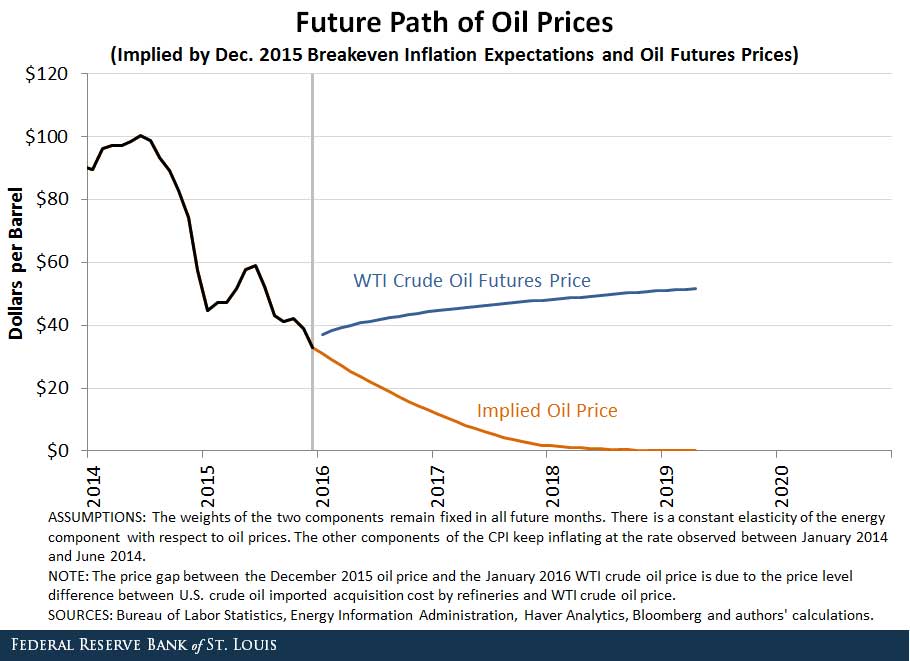
The St Louis Fed performed a neat statistical trick.  They look at inflation protected bonds and get the forward looking rate of inflation.  Then using the elasticity of oi with respect to consumer spending, they find oil prices are predicted to be zero!, the red line.  The blue line is the future price of oil as estimated in the future market.

So, if I am a human portfolio balancer, why would I have two contradictory futures in my head?  Because I don't, I am using the inflation protection bond as an insurance policy.  I am protecting against the worst case,  not predicting the mean result.  Some economists know this, including Yellen.  It's like an fire insurance deductable.  The trader can cover the first 20k of a house fire, bur if the whole house goes up, he wants insurance.

When the tide goes out

The we see the butts of all the traders fooled by fraud. 
MarketWatch: There’s a big difference between companies’ advertised performance in 2015 and how they actually did.
How big? With most calendar-year results now in, FactSet estimates companies in the S&P 500 earned 0.4% more per share in 2015 than the year before. That marks the weakest growth since 2009. But this is based on so-called pro forma figures, results provided by companies that exclude certain items such as restructuring charges or stock-based compensation.
Look to results reported under generally accepted accounting principles and S&PSPX, +0.44%   earnings per share fell by 12.7%, according to S&P Dow Jones Indices. That is the sharpest decline since the financial crisis year of 2008. Plus, the reported earnings were 25% lower than the pro forma figures—the widest difference since 2008 when companies took a record amount of charges.

Hillary and Donald

Buzzfeed: If Hillary Clinton manages to beat Bernie Sanders, the early primaries have already revealed that there’s only one strategy for the general election against a Republican, be it Donald Trump, Marco Rubio, or Ted Cruz: Scorch the earth.
There was a scenario, which looks more like a fantasy, in which Clinton was a movement. Women in their twenties, thirties, and forties would rally to her the way black Americans rallied to Obama; she would run on her own mantle of change.
In reality, nobody is that excited about Hillary Clinton, and young voters, women and men — the foot soldiers of any Democratic Party movement — aren’t coming around. She lost a resounding 82% of voters under 30 in Nevada. Her campaign now rests on the hope that voters of color like her well enough, if nowhere near as much as they like Obama. And that means that when she faces a Republican, she will have to destroy him — something the people who will be doing the destroying acknowledged when I asked them earlier this month.

The polls have Hillary and Donald neck and neck.  The economy in the doldrums, if not outright recession.  Trump will storm through, not Hillary.  Obama missed the sea change, he still lives in the Doonsebury version of political correctness.   The antiestablishment hatred is strong,  The millennials know they have to choose the method of their recession in 2024.   They also have to watch the monetary regime change carefully, keep the Swampers from sending out the drunken helicopter pilot.  Voters will choose the blunt, candid candidate, Trump.

Boomers cashing in their pension pile

EdWeek: Teacher-retirement systems are supposed to provide a measure of security in exchange for years of service. But for new teachers in Illinois, that's looking increasingly unlikely.
Nearly a quarter of newly hired teachers will never vest in the state's Teacher Retirement System, a new analysis says. What's more, three quarters won't even make back what they pay into the system.
Those statistics are the result of changes made by lawmakers in 2011 to scale back costs, according to the analysis, by Bellwether Education Partners, a Washington-based consulting firm.

Familiar problem.  If you are a boomer take what you can get now, let the millennials sort the mess later,

Boomers cashed in on their homes

MarketWatch: A new report from the New York Federal Reserve shows older Americans have been ramping up their debt while younger Americans have not.
In real terms, debt in the hands of Americans between 50 and 80 years of age has increased by 59% since 2003. At the same time, the aggregate debt of those age 39 has dropped by 12%, the report released Friday shows.
The New York Fed report examines why. Mostly it’s a function of the housing boom and bust.
Home-secured debt, per capita, has surged 47% for those age 65, for an increase of $11,191, while it’s dropped 28% to $8,195 for those aged 30.
That makes sense as older Americans with a home, facing declining prices after the housing market collapsed but also declining interest rates, refinanced. At the same time, younger Americans were less able to get on the housing ladder, either because they didn’t want to since their job prospects were diminished and they were struggling with student debt, or they couldn’t because banks had made lending more difficult.

We will also find that the new home sales were dominated by boomers taking retirement, taking advantage of the Chinese home buyers. But the  millennials cannot afford rent, especially here in California.  The middle class exit from California is a mix, retirees going to cheaper environments, and middle class millennials doing the same.  Does the legislature ut here get the problem? No, they are busy comparing breast size.