Beacon Technology: Retailers are using technology in new ways to improve the shopping experience at their stores. One key component of this is beacons, which use a person's mobile device to customize the shopping experience. Find out more in this video in which Maya Mikhailov, cofounder and CMO of GPShopper, explains how beacons work and why they matter.Except the mobile device is your SmartCard, not your phone. Tim Cook got this backwards.
Wednesday, November 11, 2015
Banker Bot and Tap Shopping

Tim Cook vs Banker Bot
Business Insider: Apple is in talks with banks in the US about creating its own mobile-to-mobile payments service that sounds a lot like PayPal's Venmo app, according to The Wall Street Journal's Robin Sidel.PayPal stock was down 1.5% in wake of the news.The app would reportedly let people send payments to each other directly from their phones, and automatically take it out of their checking accounts on the back end.While Apple already has its own payments system thanks to Apple Pay, the service so far has been mobile-to-merchant, and the mobile-to-mobile space has largely been dominated by PayPal's Venmo app, which allows for quick and easy mobile-to-mobile payments.
Tim is still a bit clueless and does not understand the pure cash system. Tim still wants banker clearing houses, but those are being incorporated into the SmartCard. His Apple Wallet is doomed as is Google Pay.
A reversal in growth

So, if both California and Texas are retail negative, then how does Texas pay for California's losing Obamacare business?
Obamacafre inflation working into the economy
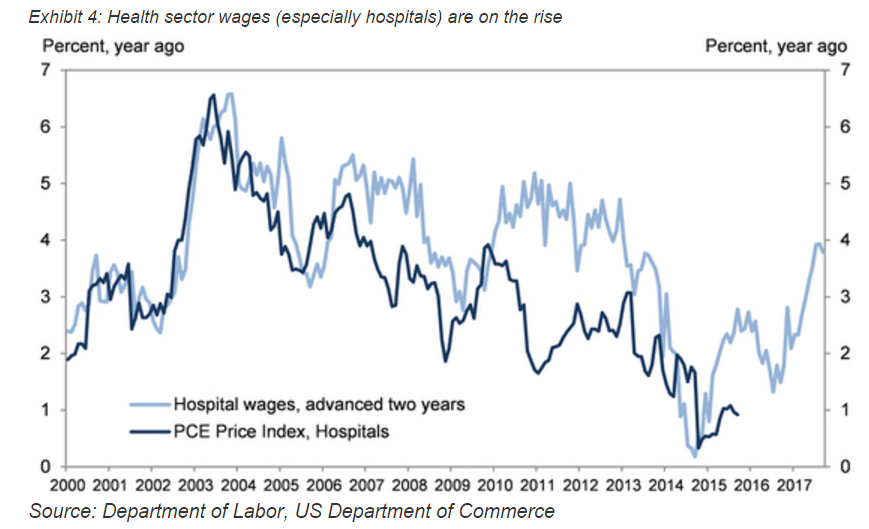
Bloomberg: Health-care costs, a significant component of the Federal Reserve's preferred gauge of inflation, are poised to accelerate, according to a new report from Goldman Sachs. "Health inflation typically outpaces economy-wide inflation, but over the last couple of years the health sector has actually been running well below the rate of core inflation," wrote economist Alec Phillips. The Fed uses the core personal consumption index as its primary metric for assessing the upward pressure on prices, and medical costs are a substantial factor to this metric. These disinflationary pressures, which have been emanating primarily from the public sector, are nearly at an inflection point, Goldman says.
The report talks about policy tweaks that have delayed costs. These tweaks mostly delay the price adjustment so that measured health care inflation is a delayed variable. Local governments are already seeing the inflation, already cutting back to make the payments.
California sticks Texas with an Obamacare bill
CalWatch: Just as the Golden State’s Medi-Cal waiver ran out, federal regulators rescued California yet again.Regulators “agreed in principle to a five-year, $6.2 billion waiver for California’s Medicaid program,” California Healthline reported. “That was good news for California health officials, who plan to use the money mainly for Medi-Cal delivery system and payment reforms — the next big steps in implementing the Affordable Care Act.”As state and federal officials work out the details of the new scheme, the current waiver, set to expire at the end of October, was pushed ahead to a new finishing date of December 31.
I cannot think of a better way to lose an election . California legislature is selling Obamacare medicaid expansion as if it were a profit center, DC having unlimited funds. Those unlimited funds in Texas are going to be spent on electioneering, making sure Texas controls the White House.
Canada is in real trouble
Newmark's Door has more info.Financial Post: Money is flooding out of Canada at the fastest pace in the developed world as the nation’s decade-long oil boom comes to an end and little else looks ready to take the industry’s place as an economic driver.Canada’s basic balance — a measure of national accounts that spans everything from trade to financial-market flows — swung from a surplus of 4.2 per cent of gross domestic product to a deficit of 7.9 per cent in the 12 months ending in June, according to analysis from Kamal Sharma, a foreign-exchange strategist at Bank of America Merrill Lynch. That’s the fastest one-year deterioration among 10 major developed nations.
Tuesday, November 10, 2015
Revision history and growth rate
Related variables. A slow growth rate requires longer look backs to achieve accuracy. It is simply a matter of allocation of significance. Low growth rates have fewer innovations. So, currently we have violent revision, then a round of smoothing revisions. We have a start and stop economy. The bean counters may not have enough innovations to find all the recession markers. We could wander around the maze forever.
Insiders can snooker banker bot
Which is the whole point of currency banking, expand the banking network by moving the insiders into the network. Banker bot just maintains the savings and loan tree, its presented odds are just the accumulation of pending bets. When the tree imbalance exceeds the bot liquidity margin, the bets are paid and the tree re-balanced. The bot records a gain or loss, depending upon the direction of the imbalance. Buts its margin is published, the risk shared and transactions costs nearly zero.
Let's narrow down this politically correct thing
A video of a politically correct professor ordering the forceful removal of a reporter.
So should we report this politically correct professor? Or should we adopt a double standard?
University of Missouri Police Ask Students to Report ‘Hurtful Speech’
So should we report this politically correct professor? Or should we adopt a double standard?
Krugman dooms Japanese with foul policy advice
Japanese Government Debt and Sustainability of Fiscal Policy
We construct quarterly series of the revenues, expenditures, and debt outstanding for Japan from 1980 to 2010, and analyze the sustainability of the fiscal policy. We pursue three approaches to examine the sustainability. First, we calculate the minimum tax rate that stabilizes the debt to GDP ratio given the future government expenditures. Using 2010 as the base year, we find that the government revenue to GDP ratio must rise permanently to 40%-47% (from the current 33%) to stabilize the debt to GDP ratio. Second, we estimate the response of the primary surplus when the debt to GDP ratio increases. We allow the relationship to fluctuate between two "regimes" using a Markov switching model. In both regimes, the primary surplus to GDP ratio fails to respond positively to debt, which suggests the process is explosive. Finally, we estimate a fiscal policy function and a monetary policy function with Markov switching. We find that the fiscal policy is "active" (the tax revenues do not rise when the debt increases) and the monetary policy is "passive" (the interest rate does not react to the inflation rate sufficiently) in both regimes. These results suggest that the current fiscal situation for the Japanese government is not sustainable.
Japan fiscal and monetary policy is unsustainable. Now, what about Obama and Bernanke? They also followed some lousy Kanosian advice.
Subscribe to:
Posts (Atom)