Showing posts with label transportation technology. Show all posts

Saturday, January 22, 2011

We are noticing our information technology

We are requantizing inventory in our entanglement with it:
The way in which people frantically communicate online via Twitter, Facebook and instant messaging can be seen as a form of modern madness, according to a leading American sociologist.
"A behaviour that has become typical may still express the problems that once caused us to see it as pathological," MIT professor Sherry Turkle writes in her new book, Alone Together, which is leading an attack on the information age.
Turkle's book, published in the UK next month, has caused a sensation in America, which is usually more obsessed with the merits of social networking. She appeared last week on Stephen Colbert's late-night comedy show, The Colbert Report. When Turkle said she had been at funerals where people checked their iPhones, Colbert quipped: "We all say goodbye in our own way."
Turkle's thesis is simple: technology is threatening to dominate our lives and make us less human. Under the illusion of allowing us to communicate better, it is actually isolating us from real human interactions in a cyber-reality that is a poor imitation of the real world.

Finally, we discovered that information technology remakes out bounded functions, we are using the Internet to define some new polynomials. What are the new quants? We drop two ranks and take a look. Fundamentally, we preplan inventory adjustments with almost and order of magnitude cut in transaction costs. As in hiring, a very expensive pursuit went from $3500 to $350. Any good is capable of that savings, in proportion.

The new model, purchases are a straight shot preplanned from anywhere to anywhere. I see this at the coffee shop. Sudden appearance of five cars, converging via preplanned social networking. All the kids move like that.

It puts stress on transportation now, but as events happen, we find great efficiencies when the Internet thingies invade the roads. If social networking and online purchases cut costs getting the near perfect quant size and delivery orders, we can minimize just about any variable, especially energy.

The new quant is the street bot, like the internet packet. We should expect an order of magnitude increase in energy efficiency, when we  make the street machines move coherent to the internet.  We had to drop two because transportation is a prime factor.

Consider my example of the young kids converging at the coffee shop. If their vehicles talked to each other and the traffic net, then their collective movement would have been preplanned across the city.  Convoy operations cuts 40% right there.  Increased safety cuts  accident rates. They would naturally go Streetbot mode within the software of the car. Short term car rentals boom, the number of vehicles on the roads drop. Singularity type gains.

Tuesday, January 18, 2011

With only a software update

Talking about platooning cars:
Some modern cars already come equipped with sensors and actuators to ensure that they don't get too close to the car in front, or don't drift out of their lane, says Robinson. SARTRE was set up to exploit these technologies, but to use them to bring vehicles closer together instead.
New Scientist

Platooning  puts the software in charge of driving and the car follows the car in front close behind. The point here is the an old idea can be implemented with the technology already existing in the modern car. A start up opportunity.

Monday, January 17, 2011

News on Autobots

Now Google has teamed up with Toyota to develop an autonomous car equipped with a video camera, radar sensors and a rotating sensor on the roof to generate a 3D map of surroundings.
Read it here.

They are going after gated communities and special venues where the Autobots get the entire lane. That scenario is today's technology, they are just catching up to market demand.

Saturday, January 15, 2011

Automated roads: A Hanson Singularity?

Even a dumb computer can drive vehicles around on asphalt roads.  If our severe depressions result from technology stressing asphalt transportation, then we have overcome a barrier.  New technology will always be directly incorporated in the automatic vehicle, we never suffer the mismatch between transportation technology and information technology.

Humans would forever discard the bounded functions needed to manage transportation, humans would thrive with new found mental energy.

Why does the Singularity presumes greater than human intelligence when all we need is greater intelligence to  manage our historically most constrained system.  The gain would hence compound as humans are free to do other things.

Here is the Hanson Singularity paper.

Farm vehicles going driverless

A team of scientists has demonstrated that it’s possible for a vehicle to drive itself back and forth between rows of trees in an orchard. The next steps are to make it easier for growers to control the equipment and to convince them that this is not science fiction, but something they will find useful in their own orchards to increase their efficiency and reduce costs.
Shuld I start a company to make an orange picker?

Posted here.

Saturday, December 25, 2010

This is big

It's not often that one can report breakthroughs in fundamental electronic devices, such as resistors or inductors. In fact, the best thing that happened to many inductors is they have been replaced by active circuitry – used, among other places, in active crossovers and other filters – that behave more like theoretically ideal inductors than the real things. But a research report published in NanoLetters is a stunning revelation of what can happen to capacitors when they are infused with a dose of nanotechnology. The title almost says everything: Graphene-Based Supercapacitor with an Ultrahigh Energy Density. Authors Chenguang Liu, Zhenning Yu, David Neff, Aruna Zhamu, and Bor Z. Jang, variously from Nanotek Instruments Inc., Angstron Materials Inc., and the Dalian University of Technology in the People's Republic of China, are merely stating the truth when they claim at the top of the supporting-information file that their research results “are of great scientific and technological significance.”
Take a fixed speed diesel, with electric drive and these batteries in between and regenerative breaking. That combo will break some Gallons per Mile records.
HT Instapundit

Thursday, December 16, 2010

Good Google News

Google is opening up App Inventor, its web software for easily creating Android apps, to everyone, the company announced yesterday in a blog post.
App Inventor launched in July, and users previously had to request an invitation to gain access to it. Now the software will drop the need for invites and move to beta status, like many Google services. By doing so, Google has enabled anyone — from novice users, to more experienced programmers — to create Android mobile apps of their own.
So the kid with parents in  the Restaurant Association can make a widget and standardize it to defeat OpentTable. Ditto with Groupon.


Now the Antiplanner presents us with another tablet app deal:
Last week, the House decisively postponed reauthorization of the Federal Aviation Administration, something it has already done 16 times since reauthorization was scheduled to take place in 2007. At stake is the future of America’s airline network, which is beholden to the federal government to maintain and update an antiquated air traffic control system.
Seriously kids, if we created Microsoft Flight simulator, then a tablet app with GPS and WiFi can be constructed to eliminate air traffic control altogether.  What do we need?  Network algorithms, Google air maps, GPS, tablet to tablet communications.  Distributed navigation, isn't that how we intend to build the networked car?

Sunday, December 5, 2010

Whoosh

Hungry? Better turn on your linear induction motor and send a metal capsule through an underground polyethylene tube to retrieve some groceries.

That’s the vision of Foodtubes, a UK program that seeks to reduce carbon emissions by building a pipeline-capsule system to deliver food and freight. A series of tubes could ferry 6-foot-long metal bins among neighborhoods, entire cities or even to different countries, moving goods at 60 mph using linear induction motors and intelligent routing software. Foodtubes says it’s “really fast food,” brought to you by the Internet of Things.

“In the long term, we could see an ostrich slaughtered in Cape Town, and delivered to Edinburgh,” said Noel Hodson, Foodtubes’ CEO, in an interview in EWeek Europe.

The group wants to start in the London suburb of Croydon with a $625 million pilot network connecting all the borough’s food shops, schools and buildings. Such a network would remove diesel trucks from the road, cutting carbon dioxide emissions by 8 percent a year and reducing congestion, the project’s leaders say.
Instapundit found this.  The idea has been around, but I think Deliverbot will win the business..

Friday, December 3, 2010

This moves things along

Japanese telecommunications manufacturer, OKI Electric Industry, has announced the development of the world’s smallest class of ultra-compact inter-vehicle communications device (Simple and Compact IVC Unit), which enables direct communication between vehicles (V2V) and between vehicles and pedestrians (Y2P). The device integrates components previously deployed externally, such as antennas used for inter-vehicle communications, LEDs/buzzer user interfaces, a GPS (Global Positioning System) module and accelerometer, allowing the device to be reduced to one-eleventh the size of the conventional device. The miniaturization should allow installation in the upper area of instrumental panels and windshields, contributing significantly to real-world implementation of inter-vehicle communications.

Wednesday, November 17, 2010

The Onion gets it!

The Anti-Planner points us to this Onion article, on high speed buses.  One thig the Onion article says is that the new buses will go 165 MPH, which seems a bit high.
As a marketing guy, I am interest in how viral this Onion article gets, I want it in the hands of transit planners.

Also of note, Brad Templeton has one of his series in Robocar essays out.  He gives a great overview of the transportation revolution underway.

Saturday, October 30, 2010

Traffic management in the UK

As these ‘professional’ drivers are using the road users in the UK contributing to its information pool, particularly business and commercial drivers. As these ‘professional’ drivers are using the road system more than any other sector of motorist, the regular and dependable data they collate is essential to the HD Traffic service. All TomTom LIVE satnav devices are equipped with a SIM (Subscriber Identity Module), which allows the vehicle’s position and speed to be anonymously fed back to the HD Traffic Centre. This gives accurate and regularly updated information on traffic flow across the entire road network. The data is then collated, analyzed and used for route planning.

That's TomTom, via Traffic Tehnology Their site. TomTom is in the company of Naveq/NXP or Skymeter; but I like their approach. Get the basic black box into as many vehicles as they can.

The traffic automation market is at the pivot point. The stimulus action we are looking for is a technology plan that makes the traffic bandwidth market liquid. Traffic bandwidth must be sold in units farther out in time and larger in size; and then remarketed.

There is one message this industry needs to produce to local transit districts, remember,  The rights they control today, along the roads, streets , parking spots,  and intersections, will gain utility fast as technology is added.  These companies add the technology, talk to them before you sell, but eventually do sell bandwidth in its liquid form.

Sunday, October 17, 2010

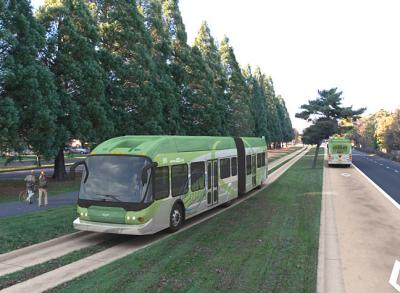
Lane design for BRT

These lanes from Eugene Oregon.  Put them together and utilize the lawn space between, take some of the recovered space and make a curb to keep pedestrians out, add lane guidance and speed things up.  These are not Podcars that roam around the park, these are high speed brutes.

Wednesday, October 6, 2010

PatrolBot

KnoxNews and HT to Instapundit

Tuesday, October 5, 2010

Pre-cast concrete for Protected Lanes

 Precast concrete pavement slab -- precut to accommodate epoxy-coated load-transfer dowels -- is lowered into place on Utah's I-15 near Clearfield.
[Photo courtesy of Road Science naming precastr concrete roadway one of the five top trends in 2010]

From the article, who is talking about the lower costs of precast?
“Precast concrete pavement systems have been shown to accelerate construction time and be economically feasible, while still maintaining the quality of conventional repair methods,” said Ken Berg of the Utah DOT Research Division.
As the virtual technical auditor for the I-15 Superhighway project, I am determined to keep per mile construction costs below $3 million per the desert run from Victorville east. That means we can service Vegas with basic road costs below a half billion, and still provide huge efficiency gains over rail.

One can actually look along the route (web map) and see plenty of meridian. Add snap together precast concrete lanes to reduce the process to two steps, dirt prep and slab assembly. Merges and over passes can use the same erector set technology.

Since the superhighway is traffic controlled, lanes are immediately reversible. Hence, very low cost single lane exchanges can cover all traffic patterns. Lanes are narrow, due to lane guidance, making simpler construction units. Modular lane units can be dis-assembled and re-assembled for route modifications.

So, the project would build a pre-casting factory mid-way, and produce the modular units. They are moved up I-15 during construction by using the same median right-of-way obtained from the rights holders. That is, move them along the super highway with the usual long constellations of rubber wheeled trains.

So on I-15, a least, we have the hope of newer, more efficient lane construction, simpler transition between existing HOT lanes and  Protected Lanes; with narrow gauge modular design, and digital traffic control from construction through operations.

The goal would be: Within a year from the start of construction to see some portion of the protected super lanes be in operation, built along with the deployment of the new HOT lanes starting very soon in San Bernardino.  In other words, get the word out to the county planners in San Bernardino.

Sunday, October 3, 2010

Off to the Farm

For a couple of days, its harvest time!

Let me recap what I see in the transportation markets. Reading the comments on blogs regarding the Nevada idea of "Pay for Speed", I find that commenters are just now getting the connection between toll roads and vehicle technology like lane guidance.

Soon consumers will get the whole connection, that speed and efficiency is safe with the new technology. The problem with Pay for Speed is the other drivers, the one who do not pay and who do not have lane guidance in their cars. These folks are the problem and the reason we have to curb off the advanced traffic on high speed tollways. That education process is taking place, especially among the transportation research groups.

Crowd sourcing in transportation, getting people to reveal where they are and where they are going, is the big thing right now. But those applications should quickly merge into the general application of semi-autonomous driving technology. Once the new applications are visible I expect a huge demand for high speed and lower latencies; demands that local transit agencies will satisfy with private toll road operators.

California is full speed ahead in converting diamond lanes into toll lanes. These toll lanes will be a popular testing ground for the lane guidance and collision avoidance technology that is now optional on many new cars.

One key here are the insurance companies, they have to continue pounding the safety features of semi-autonomous driving. Once the consumer tries out the autonomous features at high speed, then the deal is done and the revolution takes place.

Let me summarize:
Drivers will love the networked semi-autonomous car. Insurance companies will love the black box. The driver then demands speed, simply because he relies on lane guidance and collision avoidance. This results in a demand for curbing the toll lanes; yields the transportation revolution.

Friday, September 24, 2010

Nice curbing machine

From Power Curbers.

Cost per mile for protected lanes:
This study, in 2003, put the cost of a lane of highway at about $1 million per mile. (The full highway was $2-3 million).

High Speed BRT can be had across the LA Las Vegas I-15 for for about a half billion. This price includes only the rural section of I-15, that is 200 miles.

So, High Speed Rail is DOA when we can go faster on asphalt at about 1/5 the cost. After all, most HSR will be limited by freight to speeds of 80 MPH since they share the track. But we can get High Speed BRT up to 140 MPH, easy, with lane guidance and curbing.

Nevada, are you listening? If so, check out Thomas A. Rubin at the Reason foundation, he gets it.

Friday, August 13, 2010

Volkswagon is expanding its autonomous vehicle lab in Silicon Valley

Says this link:

Volkswagen is expanding its Silicon Valley lab where researchers "design the cars of the future" — including driverless race cars and vehicles that talk to one another.
Volkswagen of America has submitted plans to move its Electronics Research Laboratory from Palo Alto to a much larger 157,000-square-foot empty office building in Belmont. Once there, they plan to expand the work force from about 40 engineers and scientists to more than 65, with the vision of surpassing a staff of 100.
Initially, the company will take up 40,000 square feet of space and will move by the end of the year, Executive Director Burkhard Huhnke said Monday.
The lab has simply outgrown its current office in the Palo Alto hills, Huhnke said. In addition to an expanding work force, the company needs more space for infrastructure to build prototypes of vehicles that, if successful, will one day hit the market.


I probably should create a separate blog for autonomous vehicle technology.

Sunday, August 8, 2010

Correcting Andrew Close about Autobot technology

He says:
“It begs the question why. In Australia, you have big trucks with three or four trailers attached in the desert. Why do you need an autonomous vehicle if you can connect them with a piece of steel?” said Andrew Close, an analyst at IHS Automotive.
When discussing the convoy of autobots crossing Asia.

The answer to his question:

If one can pull four dumb trailers across Australia, then adding digital assist to the trailers allows you to pull 10 or 15 at a time.  Digital assist, with electric steering of the trailer greatly increases the number of traalers, and increases the types of roads on which trailer trains can travel.

Tuesday, July 20, 2010

Robocars, Driver's License, XML

Three things that mix. The robocar industry can define a specification for a generic robot driving rule set. The XML formatting language, the functional version of HTML, is designed just for that, and can reformat the rule set to look like a driver's manual. In other words, our instructions for a particular robocar on the streets will be from a web page like thing.

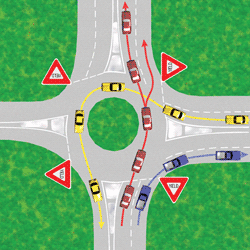
Typical Diagram from the California Driver's handbook
Web designers can look at any DMV driver's manual and immediately see definitions that could make a set of web pages illustrating driving rules. Most of the rules involve two dimensional zone s around the robocar, with predicates on those zones. With this definition we can define rules for all the bots, and restrict their behavior based on these rules. Simultaneously we give manufacturers a design goal.

Security?
It must ultimately be guaranteed by periodic, out of channel,  human intervention and hardware CRC checks.  It can be done. The software chain for public streets being enforced by mandated GPS location receiver. 

Location:
I still argue for location based link layer addressing in DSRC.

Saturday, July 17, 2010

Don't count on it

Traffic Technology reports:
Working with the US Department of Transportation, Lockheed Martin will refine and validate the requirements and architecture for the new IntelliDrive communications infrastructure, which will ultimately permit safety and traffic systems to communicate. This 15-month contract is valued at approximately US$2.6 million.

IntelliDrive is a multimodal initiative that aims to enable safe, interoperable networked wireless communications among vehicles, the infrastructure, and passengers’ personal communications devices.

“This program leverages our extensive experience in developing wireless network architectures,” said Jim Quinn, vice president with Lockheed Martin’s Information Systems and Global Solutions-Defense. “We look forward to helping the DOT establish a new vision of preventative vehicle safety and mobility within the United States.”
 Government is better off funding an Open Source consortium.  Lockheed has zero experience with civilian wireless networks.  They have likely already spent the $1.5 million and will plan on coming back for lots more, and little will result.

To the Open Source community.  We need to move forward with an Open Source implementation of Navigation Logic for the autobots.  Suggest we usurp this Lockheed contract, and contact Jim Quinn and force him on board an Open Source version of the Black Box.  Like this effort described in the Linux Journal.