No, look at the model. Inflation at the short end of the bankers network spreads up the bankers yield curve. The variance at each inventory level is too large to maintain the rank,and the bankers reduce rank. The adjustment takes time, and during that time Keynesians think we have growth, not just expensive adjustment. Go back to the Dynamic Yield curve from mid 2004 to 2007. The Fed is chasing inflation, and so is the entire network. It takes them three years to get the curve adjusted then a sudden collapse when they find a requantization that allows them to reduce rank. Keynesians get fooled, they think we have infinite dimensionality.
MIT is working the problem.
Wednesday, February 2, 2011

Why do Fibonacci series appear in manufacturing and investing?

Look at the Fibonacci generator above. Think of it as the reverse, or dual of a manufacturing network. Start at the root which represents a completed product made from eight quants of input. The eight units are represents at the leaves, and are taken from the width of the tree. What is the minimum number of sequences needed to manufacture that product? We need to decompose the eight units of input in a final product using the minimal stages of decomposition while keeping inventory variance minimal. We march up the tree from the root counting the tree width as we go.
The path from each each unit of input to the final product is the minimal number of steps. So 8 units are combined into a sub assembly of 5, combined into a sub assembly of 3, until we get a sub assembly of 1 constructed from the 8 units of input. The width at the top says one unit of output needs eight units of input.
Why not take all eight components to final assembly? Because congestion rises as the eight units still require eight assemble steps. Input inventory has to be purchased in groups of eight. Queuing is not minimal, because any delay jitter in the assembly causes input inventory to jump in units of eight. The assumption is that there is no transaction cost in moving inventory from one stage to another, so F spreads the inventory variance maximally among the steps using integer whole counts of input.
Let's apply this solution to the bankers yield curve at equilibrium:

By the way, I should mention how I derived the numerator in the equation above, log(vi). I went back to my Huffman encoder and scrolled down to their sample chart. And there discovered that the information content in bits should be the signal power and was log(wi) in the example. Proof by Wiki, is that valid?
Where do we send printed money?
When it comes to paychecks, Wall Street's law of gravity is back in full force: What goes down must come back up.Kind of nonsensical results from monetary stimulus theory do you think? Anybody hazard to guess that maybe Keynes never figured out the sparse solution problem?
In 2010, total compensation and benefits at publicly traded Wall Street banks and securities firms hit a record of $135 billion, according to an analysis by The Wall Street Journal. The total is up 5.7% from $128 billion in combined compensation and benefits by the same companies in 2009. WSJ
Big HT to Zero Hedge who watches this crap unfold.
Hawaii is one costly state for federal taxpayers
They get $1.44 back for every dollar sent to Congress. Chief porker is persuaded to give them up for a while:
However, his two Congressional districts can pork all they want, in proportion. Ms. Bachmann, are you figuring out proportional representation?
My Senator Boxer has been paying this guy off for eight years in order to get big money losing federal programs.
A renowned earmarker, Senate Appropriations Committee Chairman Daniel Inouye (D-Hawaii), announced that his panel will ban earmarks from any bills in the next two years, a move that would effectively block senators from sending money to their home states in spending bills.
However, his two Congressional districts can pork all they want, in proportion. Ms. Bachmann, are you figuring out proportional representation?
My Senator Boxer has been paying this guy off for eight years in order to get big money losing federal programs.
Florida Gov works the pension problem
Gov. Rick Scott released his plan Tuesday to cut costs in the state's pension fund by requiring all public employees — including teachers, police officers, current state workers and other government employees — to contribute 5 percent of their salary.
"We must bring Florida in line with the private sector and nearly every other state in the country by requiring government workers to contribute towards their own retirement," Scott said in an announcement.
The employee contribution would apply to the more than 650,000 government workers, ranging from firefighters and judges to clerks and cafeteria workers, who are covered by the Florida Retirement System.
"We must bring Florida in line with the private sector and nearly every other state in the country by requiring government workers to contribute towards their own retirement," Scott said in an announcement.
The employee contribution would apply to the more than 650,000 government workers, ranging from firefighters and judges to clerks and cafeteria workers, who are covered by the Florida Retirement System.
Kent Conrad has three Congressional seats behind him
And he thinks some how he has authority on the deficit? His delusion of power is enough to distrust anything the man says, and why would any senator with 20 or more Congressional districts take him seriously? He is barely more expert on the deficit than any of us. His state earns $1.68 for every dollar sent to Washington, the guy is not serious.
At least Colorado is up to 8 districts, peanuts compared to California at 53, but still Mark Udall will be completely ignored. His call for a balanced budget amendment is a call out to his puny 8 districts, nothing more.At least Colorado contributes 19 cents of every dollar sent to Washington DC.
I don't think Congress can escape the mal-apportionment and default increasingly looks more like a better outcome outcome, at least it is certain.
Boxer with her 53 districts is perfectly willing to lose 15 cents of every dollar the state sends to Washington. Unless Jerry Brown talks to the woman about the near bankruptcy of the state, nothing is going to change. You have to get the loser states, California, New York, New Jersey to discover that 15 to 40 percent of their federal taxes never return. New Jersey has 15 districts, go talk to Chris Christie, he is giving up 45 cents of every federal tax dollar to Washington. He might get real support for stopping the borrowing with his 15 districts and Camden a war zone between Black and Hispanic.
New York has 29, and New York Senators have historically let Washington keep 15 cents of their dollars. They are as broke as California, and as long as Schumer is willing to sell his state down the river, there will be no debt reduction.
Here is a 2005 list of net received and gained, from the Tax Foundation.
Washington DC gets $5.55 back for every dollar, but it is a convenient place to put poor African Americans I suppose.
Virginia does well at $1.55, isn't Eric Cantor the chief spender from that state?
Look what Harry Reid did to Nevada as a senator, damn near bankrupting the state with his federal spending. His state is the second biggest contributor, just ahead of New jersey. Who are the bozo Senators from New Jersey? Something is wrong.
And of course the welfare queen herself, Sarah Palin, Alaska making a bundle on federal handouts.
Oh yes, the Dead Kennedys , giving up 19 cents to the dollar in Massachusetts.
At least Colorado is up to 8 districts, peanuts compared to California at 53, but still Mark Udall will be completely ignored. His call for a balanced budget amendment is a call out to his puny 8 districts, nothing more.At least Colorado contributes 19 cents of every dollar sent to Washington DC.
I don't think Congress can escape the mal-apportionment and default increasingly looks more like a better outcome outcome, at least it is certain.
Boxer with her 53 districts is perfectly willing to lose 15 cents of every dollar the state sends to Washington. Unless Jerry Brown talks to the woman about the near bankruptcy of the state, nothing is going to change. You have to get the loser states, California, New York, New Jersey to discover that 15 to 40 percent of their federal taxes never return. New Jersey has 15 districts, go talk to Chris Christie, he is giving up 45 cents of every federal tax dollar to Washington. He might get real support for stopping the borrowing with his 15 districts and Camden a war zone between Black and Hispanic.
New York has 29, and New York Senators have historically let Washington keep 15 cents of their dollars. They are as broke as California, and as long as Schumer is willing to sell his state down the river, there will be no debt reduction.
Here is a 2005 list of net received and gained, from the Tax Foundation.
Washington DC gets $5.55 back for every dollar, but it is a convenient place to put poor African Americans I suppose.
Virginia does well at $1.55, isn't Eric Cantor the chief spender from that state?
Look what Harry Reid did to Nevada as a senator, damn near bankrupting the state with his federal spending. His state is the second biggest contributor, just ahead of New jersey. Who are the bozo Senators from New Jersey? Something is wrong.
And of course the welfare queen herself, Sarah Palin, Alaska making a bundle on federal handouts.
Oh yes, the Dead Kennedys , giving up 19 cents to the dollar in Massachusetts.
Tuesday, February 1, 2011
Krugman on inflation volatility and wages
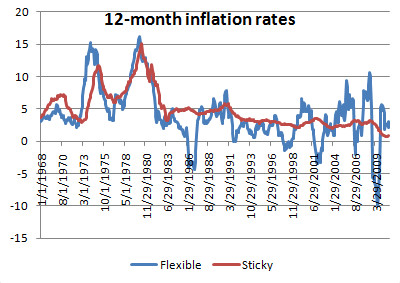
I stole Krugman's chart.
He connects wages and inflation via the Phelps relationship.
The Phillips curve is a historical inverse relationship between the rate of unemployment and the rate of inflation in an economy. WikiKrugman explains that wages were less volatile because the cost of living adjustment (COLA) was destroyed in wage deals, decoupling the Phelps relation. Hence, absent the COLA's, volatile commodities do not couple back into stable prices. And Lawrence Lux's responds, saying tax cuts and consumer debt insulated wages from inflation volatility and decoupled the Phelps relation.
My view, as my hoards of readers know, is that business shifted wage expenses onto government via the entitlement system and Reagan tax cuts; government covering present payments to future retirement costs. The time line is too long to explain the problem from consumer debt. The Phelps conclusion that wages and inflation should match shuld include quantization effect, the loss of precision when large government programs cover much of wages, indirectly. The wage settings dropped rank, as I say, and wages still follow inflation, but with a much longer adaptation time. Unfotrunately, the downward adaption in wage subsidies by government happens under the threat of default..
Persian cowardice
Iran said on Tuesday the uprising in Egypt will help create an Islamic Middle East but accused US officials of interfering in the "freedom seeking" movement which has rocked the Arab nation.
"With the knowledge that I have of the great revolutionary and history making people of Egypt, I am sure they will play their role in creating an Islamic Middle East for all freedom, justice and independence seekers," Foreign Minister Ali Akbar Salehi was quoted as saying on state television's website.
Salehi, who was officially endorsed by the Iranian parliament on Sunday as foreign minister, said the uprising in Egypt "showed the need for a change in the region and the end of unpopular regimes."
"The people of Tunisia and Egypt prove that the time of controlling regimes by world arrogance (the West) has ended and people are trying to have their own self-determination," said Salehi, who also currently oversees Iran's controversial nuclear programme. An AFP News story via Breitbart
The history behind the news is the ancient Persian fear of marauding Arab Islamic tribes. Iran is scared shitless.
Channel interference

This is mutually shared sample space, in this case the interfering variance, dominated the 30 year term. How does the rest of the yield curve respond? The terms move toward the stuck position; investors crowd around noise, grabbing yields. The remaining terms rose up and to the right to "tune out" the cause, including the Fed chasing inflation nearly all the way.
Feb 23, 2006, that was the crashing of house prices. Look here at the inflation chart. After a peak in fourth quarter 2005, inflation dropped off for the remainder of 2006. Business continued as usual, amazingly with the Fed inverting the curve until Jun 2007, the start of the crash.

We get collision, short term interest rates high and investors caught long in the bond market. But the point here is I need to extend channel theory to handle channel interference.
Modelling the process of adjustment.
Before taking this theory farther, we need a simple model of adjustment durig epansionadn contraction of the economic bandwidth. Her do investors jump in and ou of the market during change?
I propose a crowd right and expand left process. During contraction, bankers shift right, readjusting their separation and keeping a Gibbs separaton. Investors at the long end get longer and longer, drifting toward a sample rate of zero, otherwise known as taking their losses. Hence we really don't have to drop rank, we can leave them in the system as dormant dead weight. I'll go back to my R Code model and try this out and report back. It will be interesting to see if micro adjustments in the model during changes result in the same scaled Fibonacci sequence, another F sequence or something different.
Fake Senator from Nevada tells us what's off the table
Nevada Sen Reid, with all of 4 Congressional districts behind him is telling California with its 53 Congressional districts what we are allowed to vote on. This idiot hasn't a clue, and California is being sunk by bozo senators like Harry Reid, who also told us that Obamacare was off the table.
It is the ignorant Senator from Nevada who is off the table, and its time California got its fair share of ignorant Senators.
It is the ignorant Senator from Nevada who is off the table, and its time California got its fair share of ignorant Senators.
Subscribe to:
Posts (Atom)