Well, they do not have the presidency of DC, so they will have a more difficult time. But have we ever known any Republican president in the last 40 years who has not run up the debt and crashed the economy? Reagan did it badly, lil Bush did it. And a quick look shows us that Bush the daddy did it.
The only president who did not run up the debt was Bill Clinton, and we had nearly 6 years of sustained growth at 4% a year, lower deficits, and the most successful economy in 50 years. In fact, the mild recession at the end of his presidency was revised away, take a look, growth was actually positive in the 2001 recession. Bean counters figured out Bill was not one of those damned Communist Republicans.
So let's all hold our breath and hope the Republican Communists in the Senate have now figured something out. I doubt it, Republicans are committed Communists.
Friday, November 7, 2014

Thursday, November 6, 2014
Does the fine structure constant scale up?
Isn't that the theoretical question in physics, can we make the larger sphere from protons and keep the spherical maximum entropy constant?
This is like the compound interest question in finance, why does the YoY interest rate increase with longer terms. The Schwarzschild radius assumes all spheres are perfect, made of infinitely divisible elements. Light is constant, hence has infinite degrees of freedom.
The fine structure may not scale up. The sun makes a great sphere but it is not in equilibrium and is making helium and emitting light. Planetary orbits seem to be limited in degrees of freedom and Lagrange points have limited stability.
The current standard physics has gravity as limitless, meaning it knows Pi exactly. But we still make adjustments based on relativity, so that cannot be the complete answer.
This is why I think free protons play a larger role and are much more prevalent than we think. Proton make the relativity adjustment where needed They add another term to the equations of the larger sphere at the boundaries.I do not buy into the concept of empty space. The vacuum cannot know the value of Pi since it must be computed as a power series, and that is a finitely quantized, sum.
How badly does the Sun compute Pi?
All by itself with no energy release, one can look at the orbital plane, its about 3 degrees. The proton is good up to 90 degrees, I think, using the Lucas number scale, and that seems to agree with the orbitals. Stable orbits are hard to create without tidal action breaking up the planets. If goes back to the degrees of freedom needed to compute a good sphere, and planets do not have that in their masses. The sun has to fine tune, like the quarks can, spreading protons out. Looking at the hyperbolic equation of the sphere, the sun does not match volume with radius. If gravity is to be accurate up to the fine structure, then protons have to be spread around until the radius and volume match at the boundary. Is that a shift left by an exponent of 17 in the Lucas numbers? Dunno, haven't thought this through. But I would be looking at Wythoff arrays if I were a sphere packer trying to scale up.
This is like the compound interest question in finance, why does the YoY interest rate increase with longer terms. The Schwarzschild radius assumes all spheres are perfect, made of infinitely divisible elements. Light is constant, hence has infinite degrees of freedom.
The fine structure may not scale up. The sun makes a great sphere but it is not in equilibrium and is making helium and emitting light. Planetary orbits seem to be limited in degrees of freedom and Lagrange points have limited stability.
The current standard physics has gravity as limitless, meaning it knows Pi exactly. But we still make adjustments based on relativity, so that cannot be the complete answer.
This is why I think free protons play a larger role and are much more prevalent than we think. Proton make the relativity adjustment where needed They add another term to the equations of the larger sphere at the boundaries.I do not buy into the concept of empty space. The vacuum cannot know the value of Pi since it must be computed as a power series, and that is a finitely quantized, sum.
How badly does the Sun compute Pi?
All by itself with no energy release, one can look at the orbital plane, its about 3 degrees. The proton is good up to 90 degrees, I think, using the Lucas number scale, and that seems to agree with the orbitals. Stable orbits are hard to create without tidal action breaking up the planets. If goes back to the degrees of freedom needed to compute a good sphere, and planets do not have that in their masses. The sun has to fine tune, like the quarks can, spreading protons out. Looking at the hyperbolic equation of the sphere, the sun does not match volume with radius. If gravity is to be accurate up to the fine structure, then protons have to be spread around until the radius and volume match at the boundary. Is that a shift left by an exponent of 17 in the Lucas numbers? Dunno, haven't thought this through. But I would be looking at Wythoff arrays if I were a sphere packer trying to scale up.
Krugman busted on another fraud
Russ Roberts nailed him and saved me the work. No charts needed. Krugman puts up a chart of dots, and even after doctoring the data, there is no compelling linear trend between government spending and GDP, nor any reason to find cause and effect. The Krugman calls it a compelling case, and the New York Times, the liar rag of all time, prints the column. Result? Economists have to spend time and effort to restore the adjective 'science; to their profession.
I have no idea why Krugman, Simon Wren Lewis, and a few others are even allowed near the classroom, and students need to beware of wasting time in Econ 101. Student should struggle through a complete series on probability and statistics, calculus, and maybe a course on linear differential equations; then take an upper division class in Econ.
I have no idea why Krugman, Simon Wren Lewis, and a few others are even allowed near the classroom, and students need to beware of wasting time in Econ 101. Student should struggle through a complete series on probability and statistics, calculus, and maybe a course on linear differential equations; then take an upper division class in Econ.
Wednesday, November 5, 2014
Did monetary policy cause inflation?
Scott Sumner asks the question:
So, has the Fed's effect in raising rates caused inflation or not? What inflation would that be? The stock market has risen like a rocket. So that would be high rates caused by expansionary policy? QE had clearly caused a one point rise in consumer prices right in 2010 that lasted a year.
How about Canada?
 See any causality? How does Nick Rowe differentiate between the bank and inflation responding to a third variable?
The issue is something called the neo-Fisher view that the central bank pushing rates beyond equilibrium causes the opposite effect. Pushing rate too high can cause inflation, too low can cause deflation. When that happens central banks do a noticeable rate cycle, they end up out of phase with price changes and are always responding too late. Canada certainly has a rate cycle, prices clearly drive the bank, not the other way around.
A little research on the web in fact tells me that the provinces in Canada are often at variance with the average inflation. In the USA also we can see inflation vary from 3 to 0 percent from Texas to New York, the USA being the worse monetary zone. So in Texas the fed will drive real rates down while waiting for New York to catch up.
What's the point here?
The USA is not an optimum monetary zone and the Fed will never get rates settled one way or the other.
Low rates caused by expansionary monetary policies are inflationary, and low rates caused by contractionary monetary policies are deflationary.Well, first of all, monetary policy is not low rates as the Fed has not executed any market move that would lower rates and the two rates it has effected, interest on reserves, is above market levels, and QE effects on long term bond rates is up. So we have no evidence on low rates since 2007.
So, has the Fed's effect in raising rates caused inflation or not? What inflation would that be? The stock market has risen like a rocket. So that would be high rates caused by expansionary policy? QE had clearly caused a one point rise in consumer prices right in 2010 that lasted a year.
How about Canada?

The issue is something called the neo-Fisher view that the central bank pushing rates beyond equilibrium causes the opposite effect. Pushing rate too high can cause inflation, too low can cause deflation. When that happens central banks do a noticeable rate cycle, they end up out of phase with price changes and are always responding too late. Canada certainly has a rate cycle, prices clearly drive the bank, not the other way around.
A little research on the web in fact tells me that the provinces in Canada are often at variance with the average inflation. In the USA also we can see inflation vary from 3 to 0 percent from Texas to New York, the USA being the worse monetary zone. So in Texas the fed will drive real rates down while waiting for New York to catch up.
What's the point here?
The USA is not an optimum monetary zone and the Fed will never get rates settled one way or the other.
Pure statistical fraud from the Economist
Confirmation bias and outright liars at the Economist Magazine.

The Swedish Bank uses an interest rate corridor:
Note the rise in raw oil imports in 2010 to 2011. At that time, oil prices rose about 40%, here:
http://research.stlouisfed.org/fred2/graph/?g=PZU
Obviously the economy was heating up faster than they could pay for oil, the Swedish bank likely responded simultaneously with the economy in cooling things off.
The Keynesians do not do the homework, they simply quote from the Book. I rarely find any of this crowd actually doing the work.
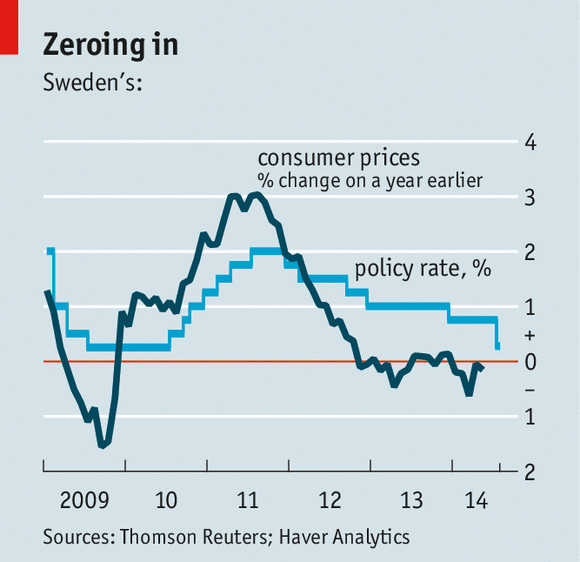
Its main policy rate reached 2% in July 2011, while rates in most other rich economies stayed near zero. Yet the Riksbank seems to have got out too far over its cross-country skis. By the end of 2011 inflation was sinking rapidly while the crisis in the euro zone deepened.Look at the graph folks, Inflation rose right after the rate hike. Why did the Economist put this data up and not explain why rates rose and inflation rose? Why do they deliberately lie right in from of the reader? Why do they bother to even exist?
The Swedish Bank uses an interest rate corridor:
What is the interest-rate corridor?The banks can deposit money overnight with the Riksbank at the deposit rate. The lending rate is the interest rate that the banks must pay when, against collateral, they borrow money overnight from the Riksbank. In this way the deposit rate forms the floor and the lending rate the ceiling for how low or how high the overnight rate can be.So they have the tools to lower and raise rates without excessive market intervention. What caused the inflation? A one time price adjustment because oil prices shot up and Swedish oil imports had risen by 50%, at the same time. Here:
| 2000's | 27 | 19 | 15 | 11 | 29 | 26 | 30 | 25 | 25 | 15 |
| 2010's | 15 | 25 | 9 | 4 |
Note the rise in raw oil imports in 2010 to 2011. At that time, oil prices rose about 40%, here:
http://research.stlouisfed.org/fred2/graph/?g=PZU
Obviously the economy was heating up faster than they could pay for oil, the Swedish bank likely responded simultaneously with the economy in cooling things off.
The Keynesians do not do the homework, they simply quote from the Book. I rarely find any of this crowd actually doing the work.
I have a new carpetbagger on his way to DC?
But it is close, too close for me to say.
Central Valley Business:
Veteran Central Valley Congressman Jim Costa, a conservative Democrat, was swept out of office Tuesday by Johnny Tacherra, a Republican, based on the final, but unofficial, vote count.
Mr. Tacherra had 50.5 percent of the total votes in the district, which is largely within Fresno County, edging Mr. Costa by 736 votes out of 69,678 cast in the election.Mr. Costa has represented the district since 2004 and earlier worked as a member of the state Senate or Assembly for 24 years.In his bid for another term, Mr. Costa was supported by the Western United Dairymen, the Dairy Farmers of America and the California Dairies Federal political action committee, while Mr. Tacherra, himself a dairy farmer, did not see that financial support.
Tuesday, November 4, 2014
Reverse Repurchase is horse manure
The idea is that the Fed wants to control the overnight lending rate for non member banks. They intend to set that rate at half the rate earned by member banks on excess reserves.
But for crying out loud, it is obviously the member banks who set the overnight rate for non-member banks because the member banks have the job of offering demand deposit rates for large institutions. The member banks set the demand deposit rate at half the rate they earn on excess reserves. That is why the non-member bank overnight lending market is at .1, and while the Fed has set member bank rates on excess reserves at .25.
Hence, the reverse repo nonsense just sets up a closed loop in the network and will be unstable as hell. The Fed will figure this out in about a week and close the program, watch.
But for crying out loud, it is obviously the member banks who set the overnight rate for non-member banks because the member banks have the job of offering demand deposit rates for large institutions. The member banks set the demand deposit rate at half the rate they earn on excess reserves. That is why the non-member bank overnight lending market is at .1, and while the Fed has set member bank rates on excess reserves at .25.
Hence, the reverse repo nonsense just sets up a closed loop in the network and will be unstable as hell. The Fed will figure this out in about a week and close the program, watch.
Monday, November 3, 2014
The market, not the Fed lowered rates in 2008

Lets list some fact for the economists:
The Fed did not lower any rates since late 2007, the market did. The market currently has the overnight rate for non member banks at .1, about the same as one year treasuries. The Fed holds the IOER at .25, that is higher than market rates. QE mostly raised long term rates and likely had little effect on inflation. The Fed cannot raise lending rates above market lending rates, except indirectly or by raising reserve requirements way up.
Why does the economy accept interest rates below the dollar deflator rate?
Because the fiat has utility equal to .8%, actually. That number seems to be the acceptable level of fuzziness the economy accepts in accounting. The cost of being more accurate is too high, it involves dealing with DC.
Is there empty space between the bubble of the cavuum?
I do not believe so, but sphere packing is never accurate. Likely that is handled by the fine structure, but I dunno. It is the omission of empty space that distinguishes bubble theory from others.
Sunday, November 2, 2014
Entropy: "Number of bits needed to transmit a message"
Says wiki, sounds OK to me. in physics bits is replaced with degrees of freedom. And there would be one degree of freedom per 'bit'. And we can use equipartiion theorem. Except that the degrees of freedom can be adjusted to the amount of energy.
In Shannon, take the noise and divide into total power (signal plus noise) of the channel; take the log and we get the maximum allowable entropy. But a lower entropy message can be encoded for fewer bits and minimum redundancy is obtained. Minimum redundancy makes this a tangent space, I think. Add that concept to equiparition.
So how would a Lucas atom go from a low quantum set to a larger quantum set? The nucleus has to give up some 'intert' like things. Inert thingies allow the added quant to be sustained for minimum redundancy. What are inert thingies? Likely related to Higgs thingies.
I guess that means coth and tanh are always within one fuzzy unit of invertable. And the orbitals are the equations of a compressible bubble bobbing in a spherical gradient of bubbles. Pick sign and direction and we have a bubble that rotates to make its surface dimples match the gradient lines. I reckoj the bubble size may be normalized to match trig functions, though not sure. But the rate of rotation of the electron bubble should be the second derivative and it adjusts radius. At each end of the spectrum the electron is either flat (degenerated) or perfectly spherical, 4/3* pi r^3 = r having two roots, ignoring the negative root. The electron either sinks or floats, rotates either left or right with coth, depending on sign convention. Otherwise, I am still a bit confused, as usual.
In Shannon, take the noise and divide into total power (signal plus noise) of the channel; take the log and we get the maximum allowable entropy. But a lower entropy message can be encoded for fewer bits and minimum redundancy is obtained. Minimum redundancy makes this a tangent space, I think. Add that concept to equiparition.
So how would a Lucas atom go from a low quantum set to a larger quantum set? The nucleus has to give up some 'intert' like things. Inert thingies allow the added quant to be sustained for minimum redundancy. What are inert thingies? Likely related to Higgs thingies.
I guess that means coth and tanh are always within one fuzzy unit of invertable. And the orbitals are the equations of a compressible bubble bobbing in a spherical gradient of bubbles. Pick sign and direction and we have a bubble that rotates to make its surface dimples match the gradient lines. I reckoj the bubble size may be normalized to match trig functions, though not sure. But the rate of rotation of the electron bubble should be the second derivative and it adjusts radius. At each end of the spectrum the electron is either flat (degenerated) or perfectly spherical, 4/3* pi r^3 = r having two roots, ignoring the negative root. The electron either sinks or floats, rotates either left or right with coth, depending on sign convention. Otherwise, I am still a bit confused, as usual.
Subscribe to:
Posts (Atom)