Friday, September 2, 2016

Social breakdown

Chicago Tribune: Margo Strotter, who runs a busy sandwich shop in Chicago's Bronzeville neighborhood, makes it a point to hire people with "blemishes."
But young people? She sighs and shakes her head.
They often lack "the fundamental stuff" — arriving on time, ironing their shirts, communicating well, taking direction — she said. She doesn't have time to train workers in the basics, and worries she's not alone.
"We are going to wind up with a whole group of people in their 40s and 50s who can't function," said Strotter, owner of Ain't She Sweet Cafe.
The basic skills of living in a metropolis are missing.  These kids, their parents and the generation before have been trapped in the government  sector.  They have never understood a rental agreement, decomposed a utility bill, or managed a savings account.  

They have always assumed the government guy comes by to fix the apartment.   Their food intake has to be managed with a special, restricted money; food stamps.  Some of these kids are barely understandable.

Eventually, their mid-understanding of politics lead them to corrupt, bankrupt government and business leaves, making their plight impossible.


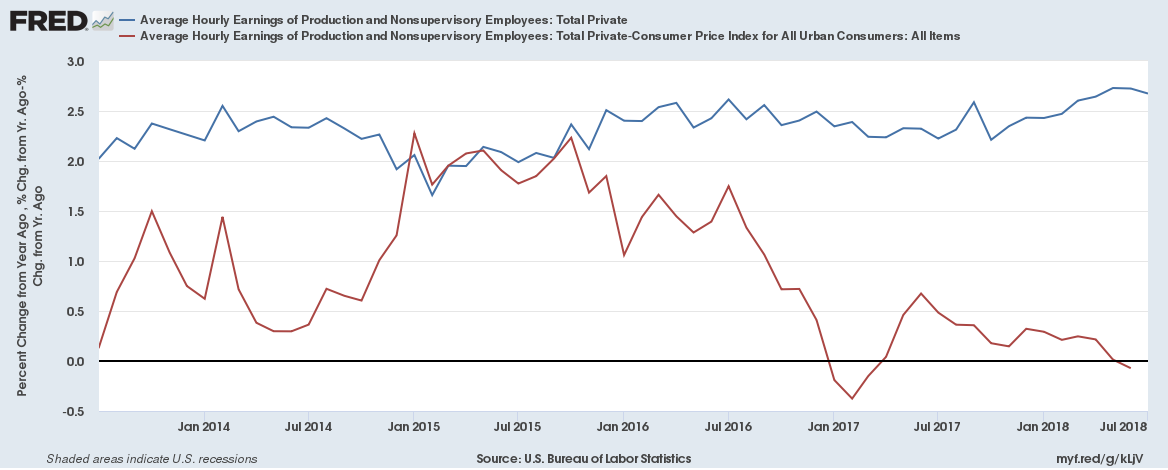
The recession is missing in action


No recession bar yet?

The labor market is holding up, it appears anyway.  Job growth was lousy, but not a crash.  I see only two mass layoffs on the horizon,.  Even if the auto industry goes through a layoff, it should already be discounted.

It is a bit scary because behind the scenes, the baby boomer retirement may be more sudden than we expect.  In other words, I fear the unemployment rate may be a misleading indicator this time around

Graph of the day


Bankrupt to bankrupter

Chicagoist:Whenever Moody’s Investors Services peers under Illinois’ financial hood, the diagnosis is rarely reassuring. As expected, the most recent news is again gloomy: The credit agency reported on Wednesday that the stopgap budget has exacerbated the state’s money woes, and Illinois’ payment backlog could reach a whopping $14 billion this fiscal year.
Expenses rose 12 percent during the stopgap budget while lawmakers failed to generate new revenue, according to Moody’s. The agency singled out a failure to counterbalance lost income after 2011 tax levies were rolled back.
"Illinois' spending is rising, even without a full package of budgetary spending authorizations, and the state projects its revenues will remain flat without any mid-year actions to raise revenues," Ted Hampton, a senior credit officer, said in a statement. "As liquidity pressure increases on the state's operating funds, the backlog of unpaid bills will almost certainly rise."
The agency said in the release it does not anticipate Illinois will change its can-kicking ways, a familiar non-strategy that will only further hamper the state’s fiscal outlook.
“A reliance on payment deferrals to offset budget imbalance has undermined the state's fiscal position for many years," Hampton said. "With each year's revenue partly allocated to prior year expenses, achieving true budget balance is virtually impossible and operating fund liquidity is constrained."

Think this through Kocherrlakota

Narayana KocherlakotaThe right answer is to abolish currency and move completely to electronic cash, an idea suggested at various times by Marvin Goodfriend of Carnegie-Mellon University, Miles Kimball of the University of Colorado and Andrew Haldane of the Bank of England. Because electronic cash can have any yield, interest rates would be able go as far into negative territory as the market required.

Mr. K and his references are still a bit confused about digital cash.  The reason Mr. K gets the properties he wants is regulation, he assumes a government regulation that all cash transaction must clear at a depository institution.    The regulation is unenforceable.   If folks ignore the regulation, then there transactions are peer to peer, and the deposit at the bank is pending indefinitely.  Even then , the cash may go through multiple transactions before being deposited.  In other words, when we ignore the silly government rule we get pure, digital cash and it has all the same properties as paper currency, we can hold secure digits in out wallet.

He compounds his contradiction:


Second, currency does provide a service beyond being a store of value and a medium of exchange: It's anonymous and thus ensures the privacy of transactions. In its absence, governments would have to allow the private sector to offer alternatives with the same attractive features.
Private actors are going to use digital cash technology, outside ot the central bank depository regime.  Hence, Mr. K has defined pure, digital cash, which can securely account and hold digits using a distributed clearing function.

Thursday, September 1, 2016

Pro football playere with huge Afro refuses to wear helmet


How do we get 6.5% China growth from these numbers?

Business Insider: The National Development and Reform Commission (NDRC) said Monday that rail freight volume in July dropped 5.8% from a year ago, to 263 million tons of cargo. For the first seven months, rail freight volume plunged 7.3% year-over-year.
But 2015 was already a terrible year.
Volume of rail freight traffic, as measured by metric tons of cargo transported and the distance traveled in kilometers, had plunged 13.4% from 2014, to 2.38 trillion ton-kilometers, according toStatista. And in 2014, rail freight volume had fallen 5.8% from 2013:

Knowledge and voting

If you want to find an electorate with the most knowledge about designing a trade regime, it is now the Brits.

 I am surprised, but I shouldn't have been.  Years ago, when ;lamenting the utter failure of current  models for government, I did a bit of looking at political science.  I found a treasure trove of valid research that shows referendums are the fastest  method to educate voters.  The scientists, used in the strict sense, found that when the major referendum was coming for a vote, the media was filled with points and counter points.  Voters, of all income classes, paid attention, and learned the issue.  Sometimes they learned too late, like the HSR in California.  But they do learn the issue.

Now the Brits, English speakers, just went through months of discussion about trade regimes, they listened, and they can instruct their representatives.  My answer?  The Brits have WTO by default, then only thing to do is adjudicate the losers and winners..

Interest rates and the reverend's parade of school girls

In my model I have two queues,depositors and borrowers.  I use maximum entropy conditions to prove a relationship between interest rates and queue size.

First, my assumption is that loan and deposit sizes are free to adjust, I use only transaction rates.  Later I cvan go back and how accurate my assumption is.

OK, the reverend has gone into the banking business, he has a queue of depoitors.  The reverend does not  want two depositors to get in the queue twice, he gets a redundancy.  Thiose two will form a wholesale lending bank and move up the banker distribution tree.

So, you see, the reverend wants all sets of unique depositors to be in his retail queue, his transaction costs are minimized.

What process eliminates redundancy in a transaction series?  The Huffman encoder, and the bankers tree is the Huffman encoding graph.  Liquidity bounds are set by setting the Huffman moving window size.

There, you have it.  The pros can add in the borrowers.   The Huffman encoder is really tracking the difference between the reverend input and output queues, using the hyperbolic model.  So the Huffman encoder, decode graph generates typical liquidity values when the banker's graph is  minimized..  Along those lines, I might think about is some.

President Trump

Rasmussen poll: Trump leads Clinton nationally