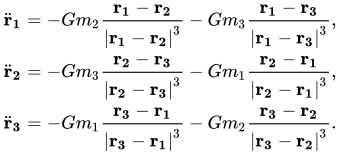
Here is is. We take the problem as one of measuring gravity. The three objects must color a sphere to some know accuracy G. We solve that then relativize it, to get back time and rectangular space but we do not get a closed form solution . Adding time is simple, count time per click and tag the coloring with the current time. Space is simple, we use three axis, and each coloring is repeated up an axis such that all object have equally dense axis.
How do the coloring ratios work? By mass, which is the inverse of coloring ratio. All we are ding is setting up the optimum element sizes for integration such that error on G is equalized. There is no flat earth closed solution because G is not known, and the three masses are maximally independent. There will be a best solution when N is estimated to be about one Avogadro.
Take an N body, like the solar system. Near he center is Mercury and he sun, two hugely different masses. Since they equally are in error of G, the to system need more accurate time and distance. to keep them partitioned.He made the floor function have more resolution, making Newton a third degree.
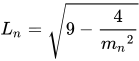
This is a condition for thinning the error counter. The four exists to support internal pending error count. The three is about three axis. So, the number of ways q can be taken tree ways minus portion of mn Must allow for 3 in the queue, or the error tree has rank four. We are encoding for messages of q types, taken three ways. It is three because the three axis share updates. Integers are whole updates. Ln is really noise in the Shannon sense, it is the ratio of total N that gives p to a good estimate.
Combinatorics. Lagrange is about combinations of error correction.
This is about combinations of a everything.

How many ways can I generate all unique combinations of set ox x elements taken over an infinite number of tries. For each set of tries, i, Euler knows the factorial giving the number of unique sequences, and he knows how much the trial space, x taken i times..
In the Lagrange equation, Mn gives you N, the total number of error updates needed to color the beach ball. It is the larger of the triples . Not all of these error updates result in a coloring.
When the Lagrange number gets to three, then p and q are an exact match, and the error tree collapses.
If we know q, the largest Markov error counter, then we know the number of buttons over any circular portion o the surface. A little geometry gets you total n, the size of the beach ball. We can use that same geometry to flatten a portion of the surface, and normalize x,y,z so they scale with update count.
Einstein had to deal with volume, r cubed, and need to carry that to get the flat earth vector space on the surface. If the three color quantum system shift up the Markov tree, we have to redo the Einstein to get flat earth.
Kinetic energy. This is an N mistmatch, the system equalizes the probability of an error update everywhere. But these updates are stable and happens in light step. The aliasing will split the axes into relative primes, we get orbits. In a spherical gas the system will split the kinetic motions.
When doing three colorings, there will be the parameter set which modifies the error tree. Most of these are best analyzed as kinetic movement along the axis. The unmodified error update allocator will always be one of the Markov points. The kinetic energy is due from a huge N mismatch which makes most models energy consuming. The models are abut adding energy in the error network to do a bit of sniff and reject on adaptation.

Given a set of x items what are all the ways we can find odd length, unique sequences. The individual ratio is the number of unique into the total possible. The hyperbolic condition the paths for sinh and cosh flows must include one path for partition flows. It is the lowest on the Markov tree.
There is a tanh differential which has a maximum second differential when the ratio is at Phi. At that point the separator is most active. The error tree optimally trimmed. All the paths of two elements for ward are even, the reverse paths odd. The each set of complete paths, one path for the separator.

No comments:
Post a Comment